If you run architecture river cruises on the Chicago River, a food tour through the West Loop, or a “gangster history” walk through the Loop, TikTok is no longer entertainment you can ignore — it’s where a huge share of your next travelers now search for things to do. For a Chicago tour operator in 2026, the play is straightforward to name and harder to run: post short, real trip moments on TikTok with searchable, keyword-rich captions; lead with a two-second hook; publish consistently under a few travel hashtags like #TravelTok and #ThingsToDoInChicago; and then answer every comment and DM fast enough to actually book the seat. This guide explains why that works, backed by real 2026 data, and how to make it fill departures instead of just racking up views.
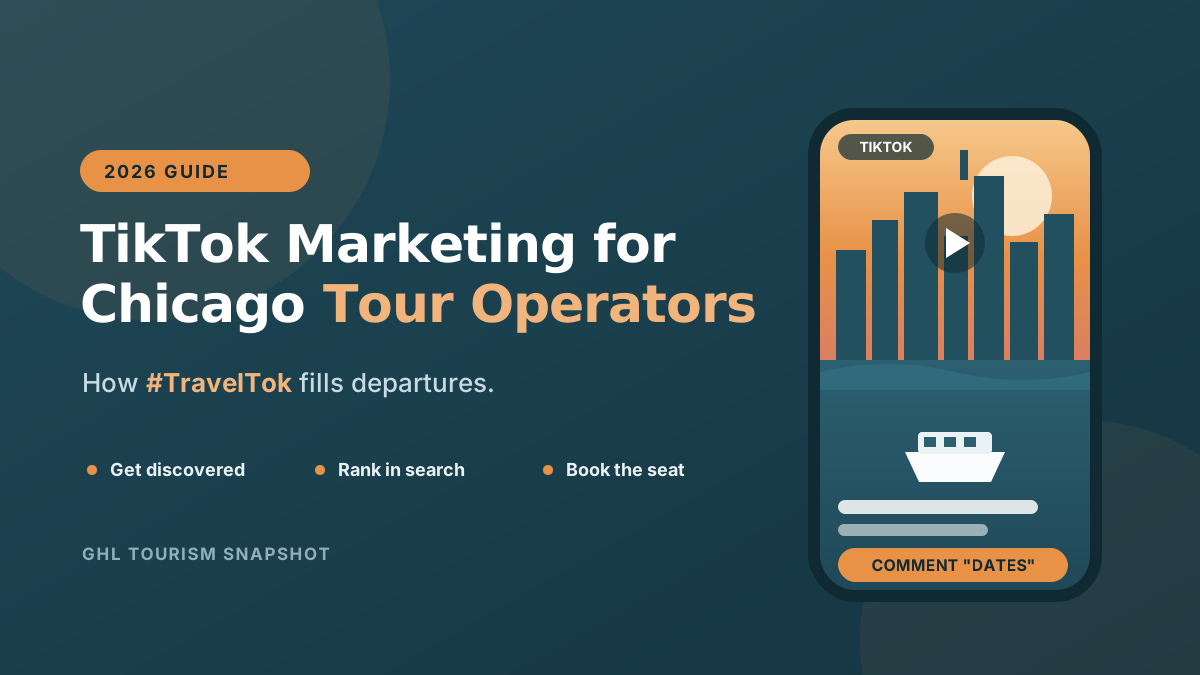
Here’s the shift that matters: a big slice of travelers no longer open Google to decide what to do in Chicago — they open TikTok and search “things to do in Chicago” the same way you’d search a map. The operator whose clips answer that search is the one who gets the 9 p.m. “any spots this weekend?” DM. The operator with a dusty, quarterly-posting account is invisible during the exact moment a traveler is deciding. Let’s break down why, and how to be the first operator.
Why TikTok is a travel search engine now
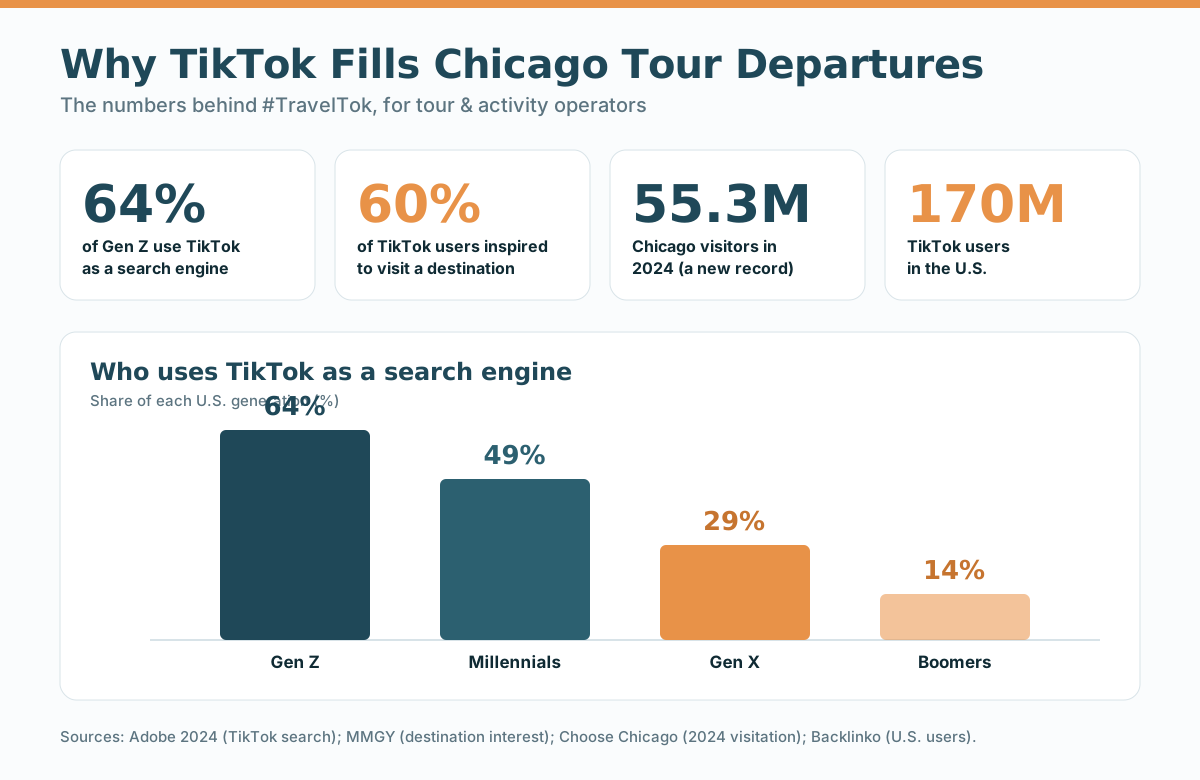
For a decade, “how does a traveler find my tour?” had one answer: they Google it. That’s changing fast, and the data is no longer subtle. Adobe’s 2024 research found that 64% of Gen Z and 49% of millennials now use TikTok as a search engine, with roughly half of all Americans reporting they’ve used the app to look something up (Adobe via MediaPost). Travel is one of the categories driving that behavior: instead of reading ten blue links about “best Chicago boat tours,” a traveler watches three 20-second clips and books the one that looks most like the experience they want.
Google itself has admitted the shift. A senior Google executive said publicly that around 40% of young people, when looking for a place for lunch or things to do, go to TikTok or Instagram rather than Google Search or Maps (TechCrunch). For a tour operator, that means a meaningful chunk of your future customers will never see your beautifully optimized website until after TikTok has already introduced them to three of your competitors.
Share of each U.S. generation that uses TikTok as a search engine. Source: Adobe, 2024 (via MediaPost).
And this isn’t idle scrolling that never converts. A national survey found 60% of U.S. TikTok users became interested in visiting a new travel destination after seeing it on the platform (MMGY via PR Newswire). With TikTok reporting 170 million U.S. users (Backlinko), the pool of travelers who will decide what to do in Chicago partly because of a TikTok is enormous — and mostly up for grabs by whichever operators show up.
Why Chicago tour operators can’t sit this out
Chicago is having a moment, and the numbers make the case for showing up. The city welcomed a record 55.3 million visitors in 2024, up 6.5% year over year, for a $20.6 billion economic impact, with international visitation topping two million for the first time since 2019 (Choose Chicago). Visitation is still climbing back toward the 61 million peak of 2019 — which means the trend line is up, and the travelers pouring back in are exactly the phone-first, socially-discovered audience TikTok reaches best.
Chicago annual visitors, in millions — recovering toward the 2019 peak. Source: Choose Chicago, 2024.
Now picture how those 55 million people actually plan. A family from Dallas landing at O’Hare, a couple in from London, a group of friends deciding Saturday’s plans over brunch in River North — a big share of them will pull out a phone and search TikTok for “things to do in Chicago,” “Chicago architecture tour,” or “Chicago food tour.” Chicago’s product is also made for the format: the skyline from the river, deep-dish being pulled apart, the Bean, a blues club at night. It’s inherently visual, which is precisely what TikTok rewards.
Sources: Choose Chicago, 2024, Backlinko, Adobe, 2024.
The competitive point is the important one. A small operator can’t outspend the big attraction brands on Google Ads. But on TikTok, a single 25-second clip filmed on a phone during a real departure can out-reach a six-figure ad budget — because the algorithm pushes content to people who don’t already follow you based on how good the video is, not how big your wallet is. That’s the great equalizer, and most Chicago operators are still leaving it on the table.
What actually performs on #TravelTok for tours
Not all tour content works on TikTok. The clips that fill departures share a pattern — and it’s very different from a polished promo video. Here’s what consistently earns reach for tour and activity operators:
Real trip moments, not ads
TikTok viewers scroll past anything that smells like a commercial. What stops the thumb is a single, visceral moment from the actual experience: the exact second the river cruise turns and the skyline fills the frame, the first bite on the food tour, a guest’s genuine reaction, the “wait, THIS is in Chicago?” reveal. Shoot it vertically (9:16), keep the camera steady, and let the real moment carry it. Authentic phone footage from your guides beats agency b-roll almost every time, because it looks like what the traveler will actually get.
A hook in the first two seconds
TikTok decides whether to keep pushing your video in the first couple of seconds. Open on motion or payoff — the reveal, the reaction, the drone shot — not a logo or a slow pan. If you use text, make it curiosity-driven and instant: “The best 90 minutes in Chicago” or “POV: you booked the architecture cruise.” No intros, no fade-ins. The payoff comes first; context second.
Short, captioned, and consistent
Aim for 15–30 seconds with on-screen captions (a large share of viewing happens on mute). Then post consistently — a few times a week, every week. Consistency is the whole game: post twice in July and vanish, and you restart from zero each time. Post four times a week for a season and you get dozens of shots at a breakout clip, because it only takes one to change your bookings for a month.
TikTok SEO: getting found in “things to do in Chicago” search
Because TikTok is now a search engine, the caption and hashtags aren’t decoration — they’re how you rank inside the app. This is TikTok SEO, and for a local tour operator it’s low-effort, high-leverage. Treat every clip like a mini blog post:
- Say and write the keywords. Put the searchable phrase in the on-screen text, the spoken audio, and the caption: “Chicago architecture river cruise,” “best food tour in Chicago,” “things to do in Chicago this weekend.” TikTok’s search reads all three.
- Use a few relevant hashtags, not thirty. A tight set — #TravelTok, #ThingsToDoInChicago, #ChicagoTikTok, plus your tour type — tells the algorithm who to show it to. #TravelTok alone is one of the most-watched travel tags on the platform.
- Pin your best “discovery” video. When someone finds your profile via search, the first pinned clip should answer “what is this tour and why book it” in 20 seconds.
- Answer questions in comments with keywords. A comment reply that says “Yes! Our Chicago food tour runs Saturdays at 11am” is itself indexable and helps you surface in search.
This is the same logic behind ranking in Google and in AI answer engines, just inside TikTok’s walls. If you want the broader picture of getting discovered across every channel, our companion guides on local SEO for tour operators and getting cited by AI answer engines cover the web side of the same strategy.
TikTok vs the platforms you already use
TikTok doesn’t replace your other channels — it plays a distinct role in the discovery-to-booking journey. Here’s how the three big surfaces compare for a Chicago tour operator:
| Channel | Primary strength | Best for |
|---|---|---|
| TikTok | Discovery from non-followers + in-app search | Reaching brand-new travelers deciding what to do |
| Warm audience + Reels reach + DMs | Nurturing interest and handling booking conversations | |
| High-intent search + Maps + reviews | Capturing travelers already searching to book |
The winning move is to feed all three from the same footage: one clip filmed on a departure becomes a TikTok, an Instagram Reel, a YouTube Short, and a Google Business Profile video. You film once and show up everywhere a traveler might be looking. (We break down the Instagram side in depth in Instagram Reels for Tour Operators.)
From view to booked seat: closing the loop
Here’s the uncomfortable truth that separates TikToks that fill departures from TikToks that just rack up views: the reach is worthless if the reply is slow. A traveler who comments “dates?” or DMs “any spots Saturday?” is a booking with a short shelf life. If you’re out running a tour and don’t see it until that night, they’ve already booked the operator who answered in ten minutes.
The data is blunt. Sprout Social’s Index found that 73% of consumers will buy from a competitor if a brand doesn’t respond on social media, and most expect a reply within 24 hours — with real-world first-response expectations for DMs measured in minutes, not hours (Sprout Social). In a high-intent, fast-moving market like Chicago travel, “I’ll reply tonight” is a booking handed to a competitor.
Sources: Sprout Social Index, MMGY, 2023, Google via TechCrunch.
So the path from scroll-stopped to paid deposit has to be short and obvious:
- The TikTok earns attention with a real Chicago trip moment and one clear CTA.
- The CTA routes the traveler somewhere frictionless — a keyword DM, a comment auto-reply, or a link to a booking page (not a generic homepage).
- The instant reply answers the question and offers the next available departure with a booking link or one-tap call.
- The booking page takes the deposit and confirms the seat, then triggers reminders so they actually show up.
Own that whole path and you keep the direct booking — which matters more every year, as online travel agencies keep taking a bigger slice of experience bookings while operators’ own sites slip. The smartest operators pair their TikTok engine with automation that answers instantly: an AI comment-and-DM agent that replies to “any spots this weekend?” in seconds, qualifies the traveler, collects dates and group size, and books the reservation onto the calendar — 24/7, in your brand voice — so a clip that pops at midnight doesn’t go cold by morning. We go deeper on that in Speed to Lead for Tour Operators and Instagram DM Automation for Tour Operators.
Doing it yourself vs handing it off
Everything above is doable yourself, and plenty of operators run it well. But there’s a reason “post to TikTok a few times a week, keep captions keyword-rich, cross-post to five channels, and reply to every DM in minutes” quietly falls apart in July: you’re out running trips. The content that fills September gets filmed in the spare time that peak season doesn’t leave you. So the account goes quiet exactly when demand peaks, and the automation you meant to set up never gets built.
That’s the gap a done-for-you service closes. Instead of you finding time to film, edit, caption, schedule, and reply, a team turns your raw trip clips into a steady stream of TikToks, Reels, and carousels, publishes them 5 days a week across all 9 channels, and runs the AI agents that answer comments, DMs, and website chat — booking travelers straight onto your calendar while you’re on the water or leading the walk.
Frequently asked questions
Is TikTok really worth it for a Chicago tour operator?
Yes — because a large share of travelers now use TikTok to decide what to do. Adobe found 64% of Gen Z and 49% of millennials use TikTok as a search engine, and 60% of U.S. TikTok users have become interested in visiting a new destination after seeing it on the platform (MMGY). With Chicago drawing a record 55.3 million visitors in 2024, showing up in those in-app 'things to do in Chicago' searches puts you in front of high-intent travelers you'd otherwise never reach.
How often should I post on TikTok?
Aim for a few posts a week, every week — consistency matters more than volume. Posting steadily for a season gives the algorithm signal that your account is active and gives you dozens of chances at a breakout clip. Posting in bursts and then going quiet resets your momentum each time. Most operators do well with 3–5 short videos a week, cross-posted to Instagram Reels, YouTube Shorts, Facebook, and Google Business Profile.
What should I film if I don't have a videographer?
Film on your phone, vertically, during real departures. Capture single moments — the skyline reveal from the river cruise, the first bite on the food tour, a guest's reaction, the view from the top. Authentic clips shot by your guides usually outperform polished agency footage because they look like the actual experience. Keep a shared 'capture list' so filming becomes a habit on every trip.
How does TikTok SEO work for tours?
Treat every clip like a searchable mini-post. Put your keyword — 'Chicago architecture cruise,' 'best food tour in Chicago,' 'things to do in Chicago' — in the on-screen text, the spoken audio, and the caption, because TikTok search reads all three. Use a tight set of relevant hashtags (like #TravelTok and #ThingsToDoInChicago) rather than thirty random ones, pin your best discovery video, and answer comments with keyword-rich replies.
How do I turn TikTok views into actual bookings?
Give every clip one clear next step (a keyword DM, a comment auto-reply, or a link to a real booking page — never a generic homepage), then answer instantly. 73% of consumers say they'll buy from a competitor if a brand doesn't respond on social (Sprout Social). Pairing TikTok with an AI comment/DM agent that replies in seconds, qualifies the traveler, and books the seat onto your calendar is how views become confirmed departures.
Is this only for Chicago tour operators?
No — the strategy works for any tour, activity, or travel operator in the USA. We framed it for Chicago because it's a high-volume, highly visual market where TikTok discovery makes an outsized difference, but the same steps apply whether you run tours in Chicago, Nashville, or Savannah. If you'd rather not run it yourself, our done-for-you social team publishes across nine channels for operators nationwide.
About the author
Desmond Clarke is a GoHighLevel agency strategist based in Savannah, Georgia. He runs a boutique agency serving travel and hospitality clients, from harbor cruise companies to multi-day expedition outfitters, and came up through paid media and conversion copywriting — so he looks at every channel through the lens of cost-per-booked-seat. On the blog he translates agency tactics into plain language any operator can act on.
Editorial note: GHL Tourism Snapshot is a GoHighLevel automation and services product, not a travel agency. We don’t sell, book, or guarantee any tour. Statistics are drawn from the cited sources and reflect industry or study averages; your results will vary with your offer, market, content, and audience.
Related posts
- Instagram Reels for Tour Operators — the Instagram side of the same short-form video strategy.
- Instagram DM Automation for Tour Operators — turn the DMs your clips generate into booked seats automatically.
- Speed to Lead for Tour Operators — why the first five minutes after a message decide the booking.
- Facebook & Instagram Ads for Tour Operators — when to put budget behind the clips that are already working.
- Direct Bookings for Tour Operators — keep the margin OTAs would take by owning your funnel.
Ready to keep your feed full while you’re out running trips? See done-for-you Social Media from $397/mo, explore the full Tourism Snapshot pricing, or talk to a real person about your Chicago tours.