
GEO — Generative Engine Optimization — is the practice of structuring your website so AI answer engines like ChatGPT, Perplexity, and Google’s AI Overviews quote your tours when a traveler asks them for something to do. It’s the sibling of SEO: instead of fighting for a blue link on a results page, you’re fighting to be the source the AI cites in its answer. For tour operators, this matters now because a growing share of travelers no longer type “best food tour in Charleston” into ten browser tabs — they ask an AI, read one synthesized answer, and click whoever the AI named. If that isn’t you, the trip is booked before you ever knew the traveler existed.
This is the operator’s guide to what GEO is, why 2026 is the year it stopped being optional, exactly how AI engines decide whom to cite, and the concrete moves that get a tour business quoted instead of skipped — with real, sourced numbers, not AI hype.
What is GEO, and how is it different from SEO?
Search Engine Optimization (SEO) aims to rank your page in a list of links. Generative Engine Optimization (GEO) — sometimes called Answer Engine Optimization (AEO) — aims to make your content the source an AI quotes when it writes a single, synthesized answer. The mechanics overlap, but the goal shifts: from “be clickable in a list” to “be quotable in a paragraph.”They’re not rivals. Strong SEO fundamentals — a fast site, clean structure, real content, schema markup — are still the foundation GEO is built on. But GEO adds a layer: writing so that a machine can lift a self-contained, factual passage out of your page and attribute it to you. A traveler asking Perplexity “What’s the best sunset kayak tour near Tampa?” gets a two-sentence recommendation with a citation link. GEO is the discipline of making that link yours.
Why 2026 is the year GEO got real
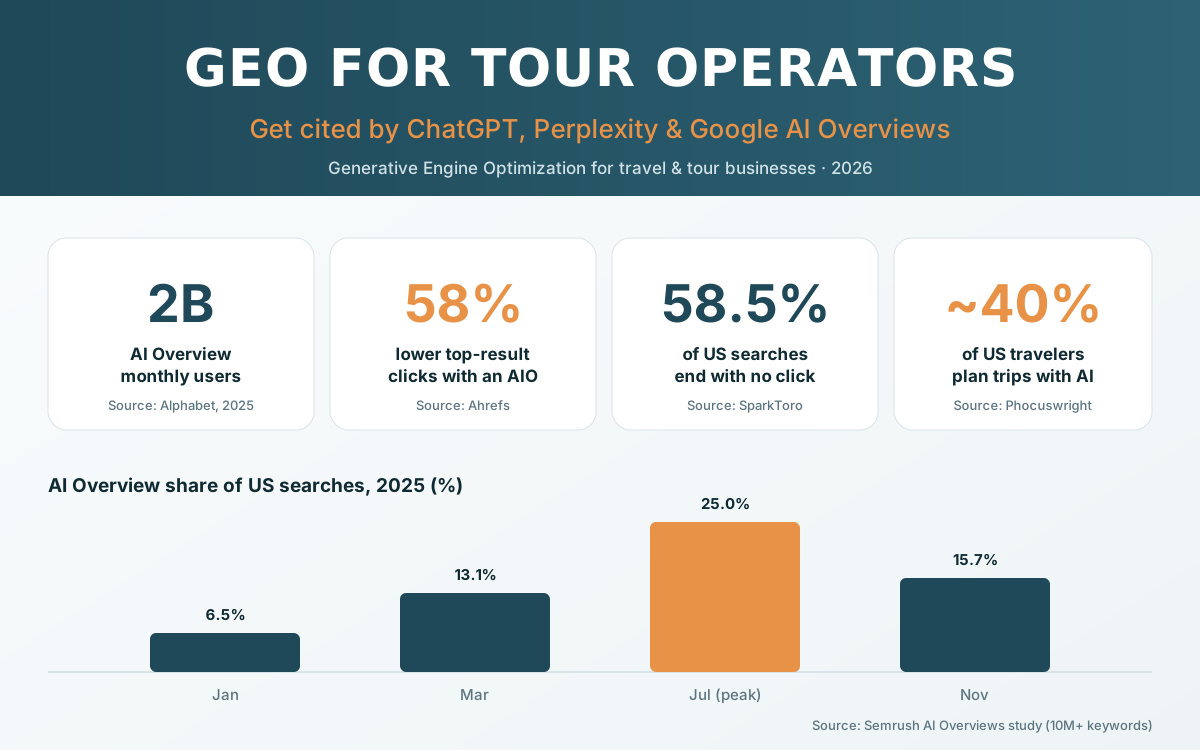
For a decade, the deal between your website and Google was simple: rank well, get a click. That deal is quietly breaking. Google’s AI Overviews now reach 2 billion monthly users and appear across 200+ countries and 40+ languages (TechCrunch, Google). Semrush’s analysis of 10 million-plus keywords found AI Overviews appearing on roughly 13% of searches in March 2025, peaking near 25% mid-year, and settling around 15.7% by November (Semrush).Here’s the part that should get an operator’s attention: when an AI Overview appears, the top-ranked organic result’s clickthrough rate falls about 58% — up from a 34.5% drop just eight months earlier — according to Ahrefs’ study of 300,000 keywords (Ahrefs). And even without AI, 58.5% of US Google searches already end without a single click to the open web (SparkToro).
Share of searches showing a Google AI Overview across 2025, from Semrush’s analysis of 10M+ keywords (%). Source: Semrush AI Overviews study.
Meanwhile, traffic from AI is climbing fast. Adobe Analytics measured generative-AI referral traffic to US retail sites jumping more than 1,200% year over year in early 2025 (Adobe), and Similarweb counted 1.13 billion AI referral visits in June 2025, up 357% (Similarweb). The traffic isn’t disappearing — it’s moving to a channel most tour operators aren’t optimized for.
Travelers are already planning trips with AI
This isn’t a “someday” trend for tourism — it’s already how a large slice of your customers behave. Phocuswright, the travel industry’s research authority, found that about 40% of US travelers used generative AI to plan a trip in 2025, with ChatGPT-style trip research quintupling since 2024 (Phocuswright). By its 2026 update, 56% of travelers had used AI for planning, booking, or in-destination help in the prior year — rising to 74% of Millennials and 72% of Gen Z (Phocuswright 2026). And 78% of travelers say generative AI improves their trip planning (Phocuswright).Share of travelers who used AI for planning, booking, or in-destination help in the prior 12 months (%). Source: Phocuswright, 2026.
Play out one query. A family lands in Savannah on a Thursday and asks ChatGPT, “What’s a good 2-hour walking history tour downtown that’s kid-friendly?” The AI doesn’t return ten links — it names two or three operators and, if browsing is on, links its sources. The operator whose website clearly states what the tour is, how long it runs, who it’s for, where it starts, and what it costs — in plain, structured, machine-readable language — is the one that gets named. The operator whose details are trapped in a slow homepage slider or a PDF gets skipped. GEO is how you become the first operator, not the skipped one.
How AI answer engines decide whom to cite
AI engines don’t “rank” in the old sense — they retrieve passages, assess trust, and assemble an answer. Across Semrush’s, Ahrefs’, and the platforms’ own signals, a consistent picture emerges of what earns a citation: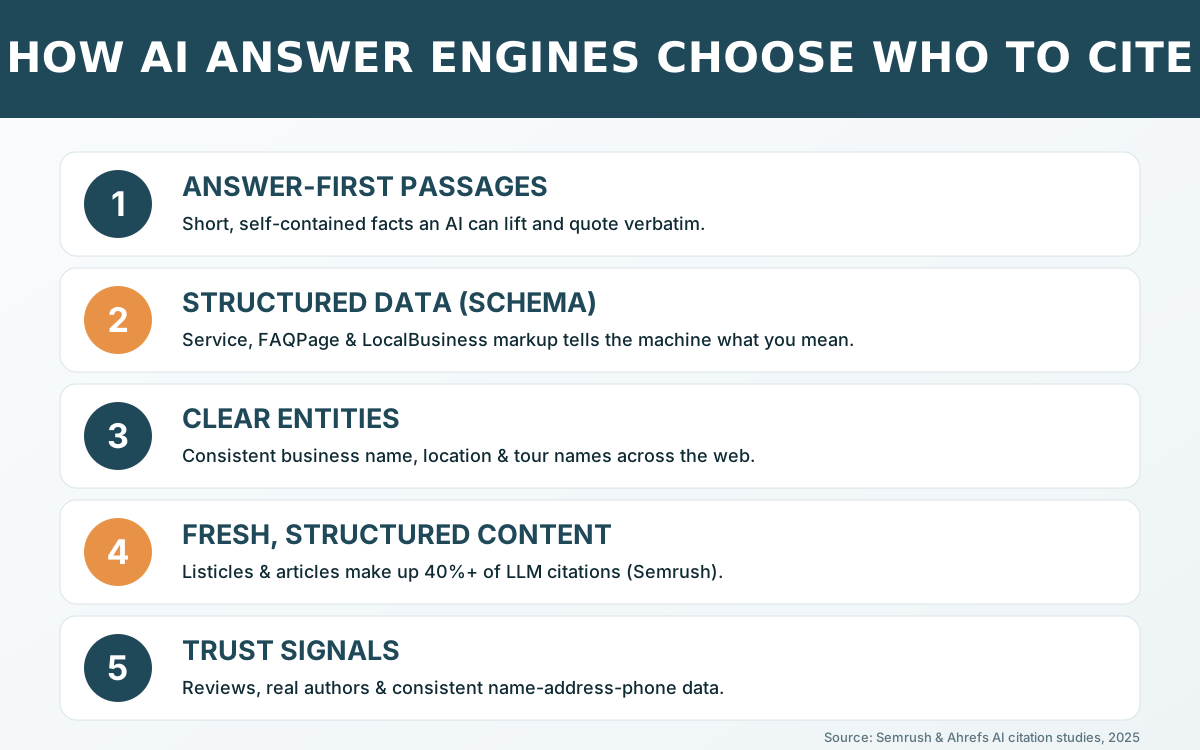
- Answer-first, self-contained passages. AI lifts short, factual chunks that stand on their own. A sentence like “The Historic Savannah Twilight Walk is a 2-hour, family-friendly guided tour departing from Chippewa Square, priced at $39 per adult” is quotable. A paragraph of brand poetry is not.
- Structured data (schema markup).
Product,Service,FAQPage,LocalBusiness, andEventschema tell the machine exactly what your page means — price, duration, area served, hours — instead of making it guess. - Clear entities. The engine needs to know who and where you are. A consistent business name, location, and tour names across your site, Google Business Profile, and citations remove ambiguity.
- Fresh, well-structured content. Semrush found fresh listicle and article formats make up 40%+ of LLM citations (Semrush). Clean H2/H3 headings, FAQs, and comparison tables are citation magnets.
- Trust signals. Reviews, real author bios, outbound sources, and consistent name-address-phone data all raise the odds the engine treats you as a credible source worth quoting.
The GEO playbook for tour operators
You don’t need a data-science team. You need a website structured so machines can read it and a habit of answering real traveler questions clearly. Here’s what actually moves the needle:- Lead every page with a direct answer. Open your food-tour page with one plain sentence stating what it is, how long, for whom, where it starts, and the price — then elaborate. That first sentence is what gets quoted.
- Add schema to every tour and service page.
Service/Productschema with price and area served,FAQPageschema on your FAQs, andLocalBusinessschema sitewide. This is the single highest-leverage technical move, and it’s exactly what a properly built Astro tour website ships by default. - Build real FAQ sections that mirror how travelers ask. “Is the sunset cruise wheelchair accessible?” “Do you run tours in the rain?” Question-shaped headings with self-contained answers are prime AI-citation fuel — and they emit FAQ schema automatically.
- Publish destination and tour-type pages with specifics. Times, meeting points, what to bring, accessibility, cancellation terms. Specifics are quotable; vagueness is invisible. (This is the same discipline behind winning local SEO and the Google local pack.)
- Ship an
llms.txt, cleansitemap.xml, androbots.txtthat welcome AI crawlers. If ChatGPT’s and Perplexity’s crawlers can’t read you, you can’t be cited. Blocking them to “protect content” quietly removes you from the answer. - Keep it fast. AI crawlers and Google alike favor fast, static-first pages; a bloated WordPress or Wix build both loses the crawl budget and buries your facts in JavaScript. (We compared the platforms head-to-head for Orlando tour operators here.)
- Earn reviews and keep your NAP consistent. Trust signals feed both local search and AI citation. A steady flow of 5-star traveler reviews and matching business details everywhere raise your credibility to the machine.
- Publish genuinely useful, current content. Fresh listicles and guides tuned to your destination — “7 rainy-day tours in Portland” — are exactly the format LLMs cite most.
Why most tour-operator sites are invisible to AI
Here’s the uncomfortable truth behind the theory: most tour-operator websites were never built to be read by a machine. They lean on a page-builder theme with no schema, hide the meeting point and price behind a booking-widget click, weigh several megabytes, and have nollms.txt at all. To Google’s AI and to ChatGPT, that site is a fog — it can’t extract a clean fact to quote, so it quotes an OTA like Viator or TripAdvisor instead. You did the tour; the middleman gets the citation and the commission.
Fixing it isn’t a plugin. It’s a site built correctly from the ground up: fast, static-first pages with proper Service, FAQPage, and LocalBusiness schema, real location pages, and a shipped llms.txt and sitemap so both search engines and AI crawlers index your tours cleanly. That’s precisely the specification we build to — a blazing-fast Astro site with a guaranteed 90+ PageSpeed, schema, AEO/GEO structure, and llms.txt included — so when a traveler asks an AI for something to do in your destination, the machine has something clean to quote: you.
How to measure GEO
GEO is newer than SEO, so the metrics are still maturing — but you’re not flying blind:- Ask the engines directly. Query ChatGPT, Perplexity, and Google (watch the AI Overview) for your key traveler questions — “best food tour in [your city],” “kid-friendly walking tour near [landmark]” — and note whether you’re named or cited. Re-check monthly.
- Watch AI referral traffic. In Google Analytics, filter referral sources for
chatgpt.com,perplexity.ai,gemini.google.com, and similar. It’s small today and growing fast — track the trend, not the absolute number. - Track branded and citation lift. As AI starts naming you, expect more branded searches and direct visits from travelers who “heard about you from ChatGPT.”
- Monitor Search Console impressions on question queries. Rising impressions on question-shaped queries where AI Overviews appear is a signal your answer-first content is being surfaced.
The honest framing: GEO is compounding, not instant — the same way SEO is. Build the structure now, keep publishing citable content, and you accumulate a moat while competitors are still arguing about whether AI search is real.
Frequently asked questions
What is GEO, and is it the same as AEO?
GEO (Generative Engine Optimization) is structuring your website so AI answer engines like ChatGPT, Perplexity, and Google AI Overviews cite your business in their answers. AEO (Answer Engine Optimization) is used almost interchangeably. Both differ from classic SEO: SEO fights for a ranked link, while GEO/AEO fights to be the source the AI quotes in a synthesized answer. Strong SEO fundamentals — speed, structure, schema — are the foundation GEO builds on.
Do travelers really use AI to find tours?
Yes, and fast-growing. Phocuswright found about 40% of US travelers used generative AI to plan a trip in 2025, and by 2026, 56% had used AI for planning, booking, or in-destination help — 74% of Millennials and 72% of Gen Z. With Google AI Overviews at 2 billion monthly users, a large share of 'things to do in ___' research now happens inside an AI answer rather than a list of links.
How is GEO different from local SEO for my Google Business Profile?
They overlap and reinforce each other. Local SEO wins the Google Map pack and 'near me' searches; GEO wins the AI-generated answer. Both reward the same fundamentals — consistent business details, real reviews, clear location and service data, and schema. A well-optimized Google Business Profile is a trust signal AI engines also read, so doing local SEO well directly helps your GEO.
What's the single most important thing I can do for GEO?
Make your key facts machine-readable. Lead each tour page with one plain sentence stating what the tour is, how long, for whom, where it starts, and the price — then add Service, FAQPage, and LocalBusiness schema so an AI can extract those facts cleanly. Answer-first, self-contained passages backed by structured data are what get quoted. Vague, image-heavy pages with no schema get skipped in favor of OTAs.
Will my WordPress or Wix site work for GEO?
It can, but most don't out of the box — they often lack proper schema, ship no llms.txt, and load slowly, which makes it hard for AI crawlers to extract clean facts. GEO is achievable on any platform with the right setup, but a fast, static-first Astro site with schema, location pages, and llms.txt built in gives AI engines the cleanest possible source to cite. That's the specification our Get-a-Website service builds to.
How long until GEO produces bookings?
Like SEO, GEO compounds rather than flips a switch. Getting the technical foundation right — schema, speed, llms.txt, answer-first content — can make you eligible for citation within weeks of indexing, but building a durable presence across engines takes a few months of consistent, citable publishing. The operators who start now accumulate an advantage while competitors wait.
About the author
Desmond Clarke is a GHL Agency Strategist based in Savannah, Georgia. He runs a boutique GoHighLevel agency serving travel and hospitality clients, from harbor-cruise companies to multi-day expedition outfitters. He came up through paid media and conversion copywriting, so he looks at every automation — and every website — through the lens of cost-per-booked-seat. On the blog he translates agency tactics into plain language any owner can act on.
Editorial note: GHL Tourism Snapshot is a GoHighLevel automation and services product, not a travel agency. We don’t sell, book, or guarantee any tour. Statistics are drawn from the cited sources and reflect industry or study averages; your results will vary with your offer, market, content, and audience.
Related posts
- Local SEO for Tour Operators: The Google Business Profile Playbook — the local-search fundamentals that also power GEO.
- Astro vs WordPress vs Wix for Tour Operator Websites — why platform speed and structure decide whether AI can read you.
- AI Chatbot for Tour Operators — capture the travelers your AI-cited pages send you.
- Direct Bookings for Tour Operators — keep the margin OTAs would take by owning your funnel.
- 6 Automations Every Tour Operator Should Run — where your website fits in the full booking engine.
Ready to be the operator AI names? Get a blazing-fast, AI-readable Astro tour website from $497 + $97/mo, see the full Tourism Snapshot pricing, or talk to a real person about your destination.