
It is a Tuesday in April, and an email lands while you are out leading a brewery crawl: “Hi! Do you run private tours? We’ve got 14 for my sister’s bachelorette on the 19th, maybe more. Can you do something special?” That is a $1,500 booking with no ad spend behind it and no commission skimmed off the top. It is also the booking you are about to lose, because by the time you reply at 7pm, she has already booked the shop that answered at 2:14pm. Here is the short version: group and private bookings are the most profitable seats you sell, and the operators who win them are not the cheapest or the fanciest. They are the ones who reply fast, quote clearly, and make it easy to say yes. This guide is the whole system, with the messages you can copy tonight.
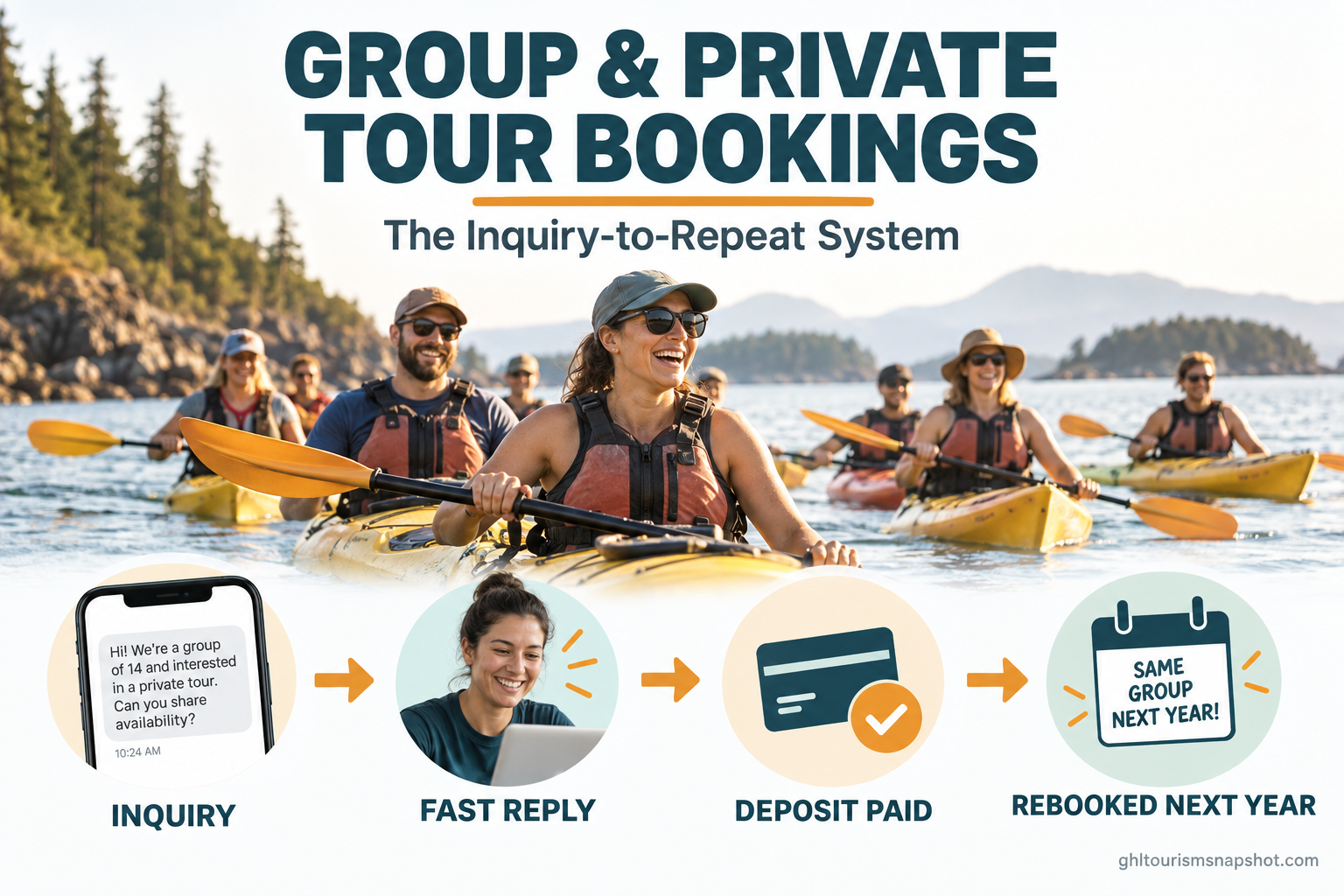
After years rebuilding the back office for small tour operators, I see the same pattern every time: the inquiries worth the most money get the worst follow-up. A 14-person private request sits in an inbox for six hours because nobody owns it. Closing that gap is almost pure profit.
Why group bookings are the best money you’re not chasing
Walk-up and single-seat bookings pay the bills. Group and private bookings pay for the off-season. A private charter, a corporate afternoon, a reunion food tour: big ticket, filling a midweek slot that would otherwise run empty, with no platform taking a cut.
That cut is the quiet part. OTA commission on activities commonly runs 20% to 30% of the ticket (GetYourGuide, via Arival). On a $60 seat you might shrug. On a $1,500 private booking, 25% is $375 you could have kept. Paid direct, that booking costs only card processing, roughly 2.9% plus 30 cents (Stripe), so you keep about $1,456 instead of $1,125.
What you keep on a single $1,500 private group booking, direct versus through an OTA. Card fee per Stripe; OTA commission range per TicketingHub.
And the demand is finding you on a phone: the mobile share of activity bookings jumped from 11% in 2019 to 28% in 2023 (Arival), so an organizer is often firing off that “do you do private tours?” message at 9pm, comparing three operators at once. Whoever replies first wins.
The group booking pipeline, stage by stage
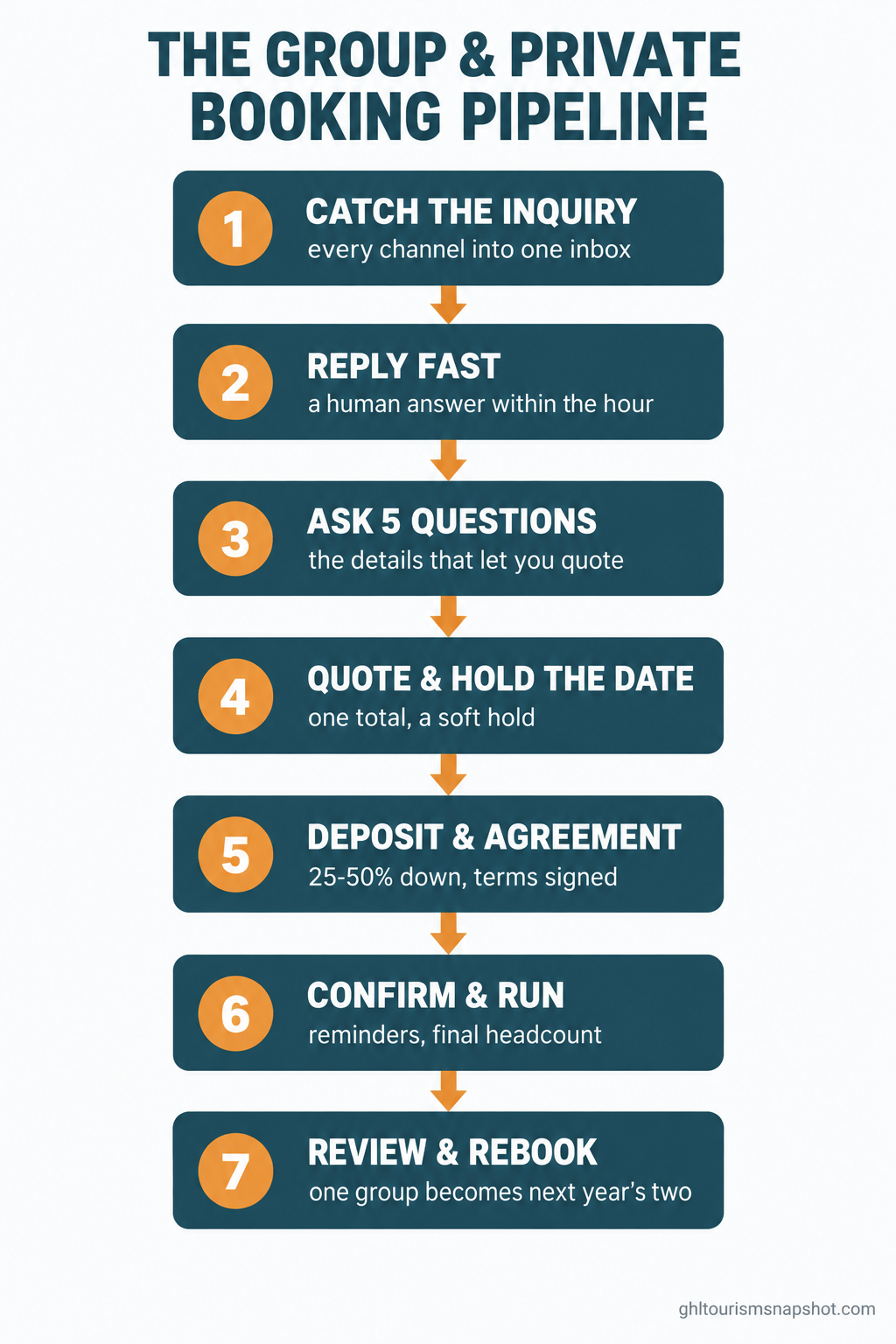
A group inquiry is a short sales process with seven steps. Miss any one and the booking leaks out: a slow reply loses it, a fuzzy quote stalls it, no deposit lets it evaporate. For each stage below: the setup, how it breaks, and the copy you can steal.
Stage 1: Catch the inquiry the second it lands
Group requests arrive from everywhere: a contact form, a Google message, an Instagram DM, a text, a voicemail while you are on the water. The first failure is not slowness, it is that nobody knows the message came in. Funnel every channel into one place that pings you the moment anything arrives and flags a group request as priority. You do not need to watch six inboxes, just one that watches them.
How it breaks: a request comes through the DM you only open on weekends, and by Monday the group booked elsewhere. If you are losing leads to channels you forget to check, start with our guide to speed to lead for tour operators.
Stage 2: Reply fast, and sound like a person
The auto-acknowledgement buys time. A real reply from a real person, within the hour, separates you from the three other operators the organizer messaged. Contacting a lead within 5 minutes rather than 30 makes you roughly 21 times more likely to qualify it (MIT / InsideSales). Meanwhile the average first response is 42 hours, and almost a quarter of businesses never respond (Harvard Business Review). Being fast is not a high bar. It just feels like one when you are also the guide and the bookkeeper.
Relative odds of qualifying a lead by first-contact time, indexed to a 30-minute reply. Source: MIT / InsideSales Lead Response Management study.
Make the reply low-effort: a short template on your phone, two details filled in, sent, and always ask for what you need to quote.
How it breaks: you reply fast but vaguely (“yes we do private tours, let me know!”), which puts the work back on the organizer and stalls the thread. Fast, human, and specific wins.
Stage 3: Ask the five questions that let you quote
Most quote delays are not price problems, they are missing-information problems. Build your intake around the five things that change the number, and collect them once, cleanly, in your first reply or a short group-inquiry form.
How it breaks: you quote before you know the headcount, then walk the price back when it turns out to be 22 people, not 14. Or you ask the five questions across five separate messages over two days, and the energy drains out. Ask once, ask all of it.
Stage 4: Send a clean quote and hold the date
A group quote should be short, scannable, and priced as a package, not a per-head puzzle. One clear total, what is included, the deposit, and a gentle time limit on the hold. A soft hold (“I can keep the 19th open until Friday”) creates a reason to decide without pressure.
How it breaks: the quote is a dense email with three tiers and tax breakdowns that reads like homework. Or there is no hold and no deadline, so the booking drifts for two weeks. One total, one next step, one soft deadline.
We build these so the quote, the hold, and the deposit link are one connected flow instead of three manual steps you do at midnight.
Stage 5: Lock it with a deposit and an agreement
A verbal “yes, we’re in” is not a booking. A deposit is. It commits the organizer, protects your held date, and gives you working capital before the trip. A fair structure is 25% to 50% down to reserve, balance due a set number of days before departure, non-refundable inside your cancellation window and refundable or rebookable outside it.
Alongside the deposit, get your terms accepted and collect waivers for the whole group up front, not at the meeting point. A clear agreement prevents the two worst surprises: the headcount that collapses the night before, and the dispute after the fact. Our liability waiver guide covers e-signatures that hold up, and the weather cancellation playbook covers refunds that keep a rained-out group out of a chargeback.
How it breaks: you skip the deposit to “keep it friendly,” and the group quietly shrinks from 14 to 8, or cancels, and your held Saturday is empty with no recourse. The deposit and the recorded terms are the same safety net.
Stage 6: Confirm, handle the wobble, and run it
The booking is locked, but a group is a moving target: people get added, people drop, the start time shifts. Absorb that with a confirm-and-remind sequence, which also cuts no-shows by roughly 34% (The American Journal of Medicine). On a group, that is the difference between a full tour and a half-empty one you already staffed.
Send an instant confirmation, a check-in a week out to lock final numbers and collect the balance, and a short reminder the day before. If you automate reminders by text, mind the consent rules, which our SMS marketing playbook walks through.
How it breaks: the final headcount is a mystery until people show up, so you over- or under-staff. Or the balance never gets collected because no one asked. Build the week-out check-in to do both at once.
Stage 7: Turn one group into next year’s two
This is the stage almost everyone skips, and it is where the real money is. Group bookings repeat on a predictable calendar: bachelorettes every year for a different friend, corporate offsites each quarter. The organizer who had a great time is your warmest possible lead for the next one, and they cost nothing to reach.
So capture the organizer as a contact, not just a transaction. After the trip, thank them, ask for a review while the glow is fresh, and plant the seed for next time. A happy group also brings referrals, because 14 people just had a great afternoon. This is how direct bookings compound instead of resetting to zero every season, which we cover in how to get more direct bookings.
How it breaks: the booking ends when the tour ends. No review ask, no record of the organizer, no nudge next spring. One follow-up message and a tagged contact fix it.
Solo, mid-size, and large operator
The seven stages do not change with your size. How much you automate, and who owns the pipeline, does.
The solo operator. You are the guide, the quoter, and the invoicer, and group requests arrive while your hands are literally wet. You do not need a sales team. You need your phone to catch every inquiry and fire the instant acknowledgement, plus three saved templates: the first reply, the quote, and the deposit request. Automate the catch so no lead dies while you are on the water, and keep the replies personal.
The mid-size operator. Three to six tour types and a couple of year-round staff, maybe a food-tour company fielding corporate requests. The problem now is that inquiries land in different places and no one owns them, so they fall between people. Put every channel into one inbox, assign group requests to one person, and standardize the quote and deposit flow. Pulling a scattered stack onto one connected platform pays for itself fast.
The large operator. Multiple vehicles or boats and a real stream of weddings, conferences, and school groups. Group and private is a revenue line with a target, not a happy accident. You want a named owner, a tracked pipeline with a conversion rate you watch, templated quotes by group type, and automated reminders and balance collection. A few points of improvement here is tens of thousands a season, which justifies custom automation built around your operation.
Common objections
“My group bookings come by word of mouth. I don’t need a system.” Word of mouth is how the inquiry reaches you. It does nothing to help you answer in ten minutes, quote clearly, or follow up next year. The warmest referral still books the operator who replies first.
“Won’t asking for a deposit scare off organizers?” The opposite. Someone planning a 14-person event is nervous about spending other people’s money on a shop that might flake. A clear deposit and a professional confirmation signal that you are real and the date is theirs. Skipping it is what gets you stood up.
“I already have a booking widget. Isn’t that enough?” A widget is great for a single seat someone buys at midnight. It is rarely built for the group conversation: the custom quote, the soft hold, the partial deposit, the changing headcount. See what booking software actually costs for where the tools stop.
“Do I need to be technical to set this up?” No. Every piece here is a message template, a form, an automated reminder, or a deposit link. You can wire it together yourself, or have it installed done-for-you. The skill is deciding that your most valuable bookings deserve your fastest, clearest reply.
Back to that Tuesday inquiry
Picture that bachelorette email again, this time with the pipeline in place. It lands at 2:14pm while you are mid-crawl, and the organizer instantly gets a warm note that options are coming within the hour. On your break you send the first reply with the five questions, and by evening you have sent a one-total quote with a Friday hold and a deposit link. The $450 is in before dinner. A week out, the system confirms her count and collects the balance. The afternoon goes great, she leaves a five-star review, and next March a text arrives: “Doing it again for my cousin, can you take 18?”
None of that is luck or being the cheapest shop in town. It is a short, reliable process applied to the bookings worth the most. Set it up once, let the catching and reminding run on their own, and keep the human warmth for the parts that need it. Your best-margin seats stop slipping away.
Group and private tour bookings: FAQ
How fast should I reply to a group tour inquiry?
Within the hour, and within minutes if you can. Replying within 5 minutes rather than 30 makes you about 21 times more likely to qualify a lead. Group organizers usually message several operators at once, so the first clear, human reply very often wins the booking.
Should I charge a deposit for group and private tours?
Yes. A deposit of roughly 25% to 50% commits the organizer, protects the date you are holding, and gives you working capital before the trip. Make it non-refundable inside your cancellation window and refundable or rebookable outside it.
How do I stop a group shrinking or canceling at the last minute?
Take a deposit up front, set a clear balance-due date (commonly 7 days before the trip), and run a confirm-and-remind sequence that also collects the final headcount. Reminder sequences cut no-shows by roughly a third.
Is it cheaper to take group bookings direct or through an OTA?
Direct, by a wide margin. OTA commission on activities commonly runs 20% to 30%, so on a $1,500 private booking you could hand over around $375. Booked direct you pay only card processing of roughly 2.9% plus 30 cents, keeping about $1,456.
What's the best way to get repeat group bookings?
Capture the organizer as a saved contact, ask for a review while the experience is fresh, and nudge them when their event is likely to come around again. Group occasions repeat on a predictable calendar, so a warm past organizer is your cheapest, highest-converting lead.
Do I need special software to manage group and private bookings?
Not special software, but the pieces need to connect: one place that catches every inquiry channel, saved reply and quote templates, a partial-deposit payment link, automated reminders, and a tagged contact record. You can assemble these yourself, or use a done-for-you system like the Tourism Snapshot that wires the whole pipeline together inside GoHighLevel.