
If your multi-day itineraries never quite fit the booking form, your manifest lives in a spreadsheet, and a chunk of every booking disappears into OTA commissions, you’ve hit the ceiling of off-the-shelf software — and custom software is how you break through it. A tour operator needs a custom build when the cost of the workarounds (manual data entry, disconnected tools, OTA dependence, features your vendor “isn’t planning to add”) is bigger than the cost of building the thing that actually fits. This guide explains exactly when that tipping point arrives, backed by current 2025–2026 industry data, and what to build first so you don’t sink six figures into it.
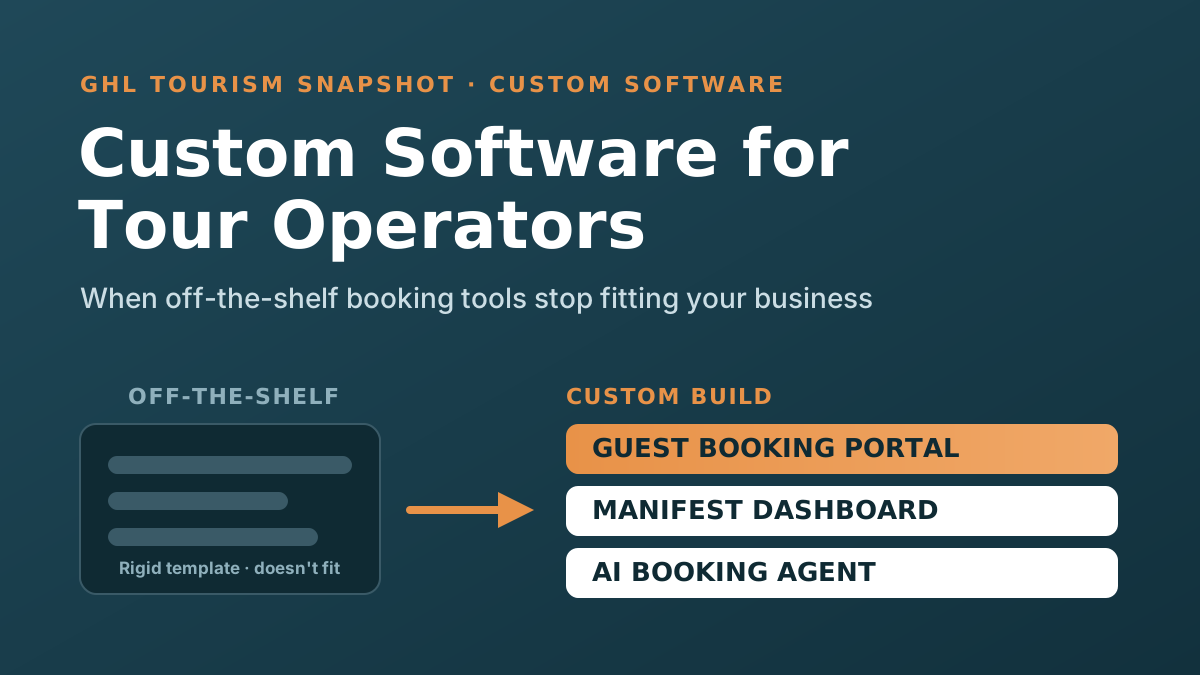
Here’s the tension every growing operator feels. Booking platforms like FareHarbor, Rezdy, Bokun, Checkfront and Peek Pro are genuinely good at the one thing they were built for — taking an online booking. But your business isn’t a template. The partner split on your co-hosted wine tour, the deposit schedule on your 7-day expedition, the branded portal where a traveler pays a balance and signs a waiver in one place — those live in the gaps the software doesn’t cover. So you bend your operation around the tool, or you patch the gaps with spreadsheets and manual work. Let’s break down when that patching stops being worth it.
Sources: Arival + Phocuswright, 2026, Arival, 2024, Bokun.
When does a tour operator actually need custom software?
The short answer: you need custom software when a specific, repeating part of how you sell or run trips doesn’t fit any off-the-shelf tool — and the manual workaround is costing you real money, bookings, or hours every single week. Not because custom is trendy, and not because your booking widget is imperfect. Because the mismatch has become a tax you pay continuously.
A few concrete signals that you’ve crossed that line:
- You (or a staffer) re-key the same booking into two or three systems because your tools don’t talk to each other.
- Travelers are bounced between an OTA, an email thread and a PDF to book, pay a balance, and sign a waiver — and you lose some of them at every hop.
- Your manifest is a spreadsheet you rebuild by hand before every departure, pulling from three places.
- You’ve asked your vendor for a feature and been told “that’s not on our roadmap.”
- A rising share of your bookings — and margin — is being eaten by OTA commissions you can’t design your way out of on a rigid platform.
None of these is a reason to panic. Every one of them is a reason to add up the hours and dollars, because the experiences industry is big and growing fast enough that the inefficiency compounds. The sector hit $271 billion in 2025 and is on track for $342 billion by 2029, growing at roughly 8% a year — faster than travel overall at 5% (Arival + Phocuswright). More travelers, more bookings, more departures — which means the per-booking friction you tolerate today gets multiplied by a bigger number every season.
The off-the-shelf ceiling: where FareHarbor, Rezdy & Bokun break
Off-the-shelf booking platforms are the right starting point for most operators. They’re fast to launch, relatively cheap, and they handle the 80% case well. The problem is the 20% that’s unique to your operation — and that 20% is usually where your margin and your guest experience live.
Here’s the pattern almost every operator eventually runs into:
Your operation doesn’t fit the template
Generic platforms assume a “product, date, quantity, pay” flow. But a real tour business has partner splits on co-hosted trips, tiered deposits on multi-day expeditions, gear add-ons, private-vs-shared pricing, waitlists, and pickup logistics. When the template can’t express those, you either drop the feature or run it manually on the side. That’s why Arival’s research consistently finds operators frustrated that their booking software lacks the operational features, integrations and reporting they actually need — the capabilities most correlated with profitability are the ones off-the-shelf vendors tend to prioritize least (Arival).
No single source of truth
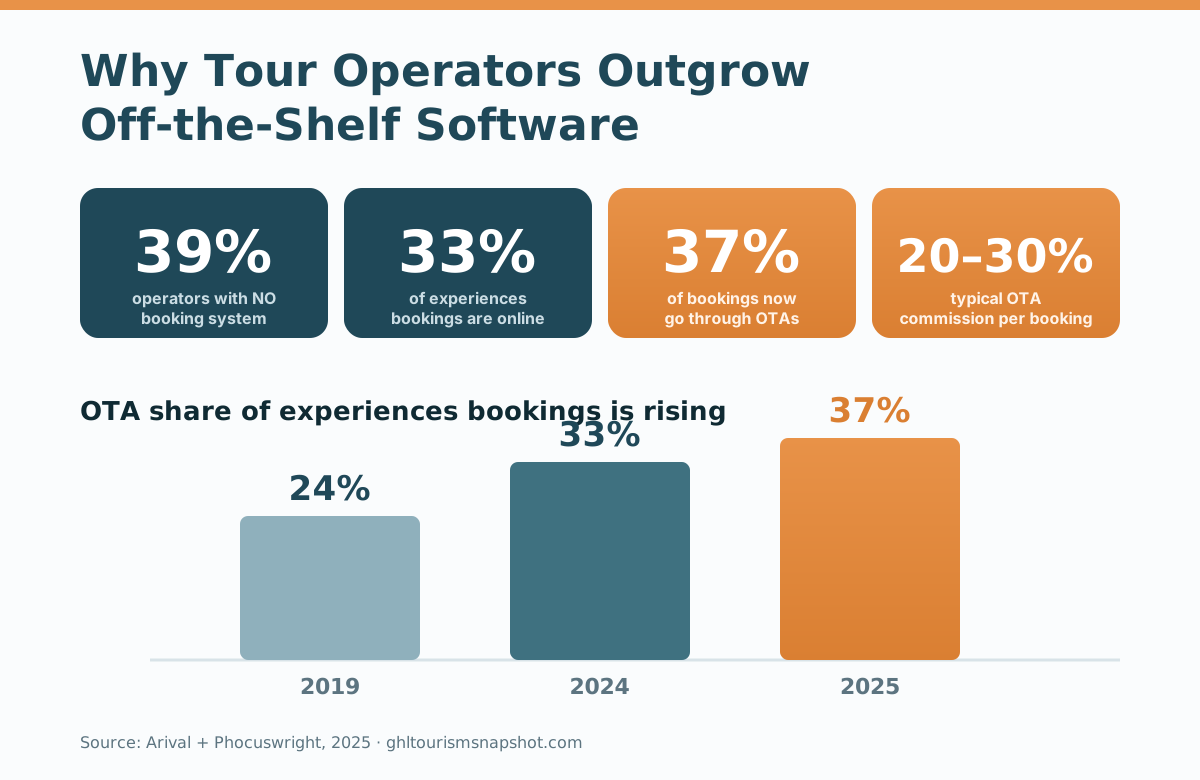
Bookings in one tool, contacts in another, payments in Stripe, reviews in your inbox, a spreadsheet holding it all together. This is the default state of the industry — remember, 39% of operators have no reservation system at all, and even many that do still stitch several tools together (Breaking Travel News). It’s not just untidy. It’s the reason you can’t answer “how many seats did each guide sell last month, by source?” without an afternoon of exporting CSVs. Scattered data means no clean automation and no clear numbers.
The platform’s ceiling is a business ceiling
The most expensive limitation is the one you can’t buy your way out of. When the feature that would transform your season — a branded guest portal, a live manifest dashboard, a dynamic pricing engine — simply isn’t on any vendor’s roadmap, the ceiling of your software becomes the ceiling of your business. The whole point of the experiences boom is that operators who can move faster capture more of it.
The hidden cost of duct-taped tools
The reason custom software is worth taking seriously is that the alternative — the patchwork of tools and manual work — is never free. It just hides its cost across two lines: the commissions you hand to OTAs, and the digitization gap that keeps you doing by hand what should run itself.
The OTA tax keeps rising
Online travel agencies are the fastest-growing booking channel in experiences, and they’re claiming more of the market every year. OTAs captured about 37% of experiences bookings in 2025, up from 33% in 2024 and just 24% in 2019 — while the share going through operators’ own websites has been sliding (Arival).
Share of experiences bookings going through OTAs, by year (%). Source: Arival, 2025.
Every one of those bookings carries a commission. Viator’s base rate is a flat 20% of the booking value; GetYourGuide typically runs 20–30%; and once you factor in the full cost of OTA dependence, many operators are effectively giving up a quarter to a third of the ticket (Bokun). To see the scale of the money in that layer, GetYourGuide crossed €1 billion in revenue and €4 billion+ in gross bookings in 2025, with commissions making up the overwhelming majority of its revenue (Skift). That margin is coming from somewhere — it’s coming from operators.
OTAs are a legitimate discovery channel; you shouldn’t fire them. But when your own booking experience is clunky, you’re pushed to rely on theirs — and a custom, frictionless direct-booking portal is how you shift the mix back toward the bookings you keep 100% of. (We go deeper on that trade-off in direct bookings for tour operators.)
The digitization gap is doing your business by hand
The experiences sector is the least-digitized corner of travel. Only 33% of gross bookings happen online, versus 64% across travel as a whole — though that’s climbing fast, from 17% in 2019 to a projected 42% by 2029 (Arival + Phocuswright, PhocusWire).
Share of experiences bookings made online, by year (%) — still a minority vs 64% travel-wide. Source: Arival + Phocuswright, 2026.
That gap is the manual work: the phone tag, the “just email me to book,” the re-keyed reservations, the abandoned checkouts. Cart abandonment is brutal even on good software — the average online cart is abandoned about 70% of the time (Baymard Institute), and travel-specific abandonment runs even higher, around 81% (SaleCycle). Every point of friction in your booking flow — a redirect, a form that doesn’t fit mobile, a balance you can’t pay online — is a traveler you lose. Custom software exists to remove that friction where the off-the-shelf tool creates it.
What “custom software” actually means for a tour operator
“Custom software” sounds like a blank check and a two-year project. In practice, for a tour operator it means a small number of well-defined tools that fill the exact gaps off-the-shelf platforms leave. You rarely rebuild everything — you build the missing pieces and connect them to what you already use. The highest-leverage builds we see for operators:
- A branded guest booking portal. Travelers browse trips, book in real time, pay deposits and balances via Stripe, e-sign waivers, upload documents, and see itineraries and trip status — all under your brand, in one place, instead of bouncing between an OTA and an email thread. Fewer hops means fewer lost bookings.
- A departure & manifest dashboard. One live screen showing every departure — seat counts, waiver status, gear add-ons, guide assignments — pulling from your booking tools automatically instead of a spreadsheet you rebuild by hand.
- An AI booking & inquiry agent. An agent that knows your trips, availability and policies, qualifies travelers by trip type and group size, checks live availability, and books the seat only when it’s a fit — 24/7, in your voice. (For the marketing-side version of this, see our speed-to-lead playbook.)
- A dynamic pricing & yield engine. Prices that flex by demand, season, lead time and seats remaining — the way airlines price — so you stop selling last-minute empty seats at the same rate as prime departures.
- Custom integrations & sync. Two-way sync between the tools you already use — FareHarbor, Rezdy, Bokun, Checkfront, Peek Pro, Viator, Stripe, QuickBooks, your CRM — so data stays consistent everywhere and your automations run on complete information.
The point isn’t to own more software. It’s to make one system out of the fragments — so the average operator’s stack of disconnected apps (the typical company runs dozens of separate SaaS tools) becomes a single source of truth (Okta).
Off-the-shelf vs custom vs a hybrid
Most operators land in one of three postures. The right one depends entirely on where your friction actually is — there’s no universally correct answer.
Three ways to run your booking tech
| Plan | Off-the-shelf only | Hybrid (recommended) recommended | Fully custom |
|---|---|---|---|
| Price | $ / low | $$ / mid | $$$ / high |
| Feature 1 | Fast to launch, low upfront cost | Keep off-the-shelf for the 80% it does well | Every workflow shaped around your business |
| Feature 2 | Great for the standard 'product, date, pay' flow | Custom-build only the pieces that don't fit | Full IP ownership, no per-seat vendor fees |
| Feature 3 | You bend your operation to the template | One source of truth via integrations | Highest upfront cost & timeline |
| Feature 4 | Features capped at the vendor's roadmap | Own your direct-booking experience | Only worth it at real scale/complexity |
| Feature 5 | OTA-heavy distribution by default | Scales without a rip-and-replace | You own maintenance & roadmap |
| Best for: new & simple operations | Scope a hybrid build | Best for: large / complex operators |
For the large majority of growing operators, the hybrid path wins: you don’t throw away the booking engine that works, you just stop doing by hand the parts it can’t do, and you reclaim the direct bookings you were handing to OTAs.
When you should NOT build custom (yet)
Custom software is a tool, not a trophy — and there are clear cases where building is the wrong move:
- You haven’t outgrown the template. If FareHarbor or Rezdy handles your flow and your data lives in one place, keep your money. Custom software solves friction you can measure, not friction you imagine.
- The gap is marketing, not operations. If your real problem is slow follow-up, missed calls, thin reviews or no rebooking engine, that’s not a custom-software problem — it’s a CRM-and-automation problem the Tourism Snapshot solves in about 24 hours for a fraction of a custom build.
- You can’t yet name the one thing to build. If you can’t point to a specific, repeating workflow that’s costing you, you’re not ready to scope. Fix the process first, then automate the part that stays painful.
Traditional custom development earned its scary reputation for a reason. Standish’s long-running CHAOS research found only 31% of software projects fully succeed, while 50% are “challenged” (late, over budget or under-scoped) and 19% fail outright (Standish CHAOS 2020). That’s exactly why scope discipline matters more than ambition — which is the whole point of the next section.
How to scope a build without a six-figure quote
The reason custom software historically cost $75K–$250K and took a year isn’t the code — it’s scope creep, big teams, and long feedback loops. The way to avoid that trap is to build the way a good operator runs a season: tightly, in stages, measuring as you go.
- Name the one workflow that hurts most. The manifest? The balance-payment portal? The double-entry between two tools? Start with the single build that pays for itself fastest.
- Scope it as a 2–6 week module, not a platform. A guest booking portal is typically a 5–7 week build; a manifest dashboard 6 weeks; an integration/sync 2–4 weeks. Small modules ship, get used, and prove ROI before you commit to the next one.
- Integrate, don’t replace. Wire the new module into FareHarbor/Rezdy/Stripe/GHL so it augments what works instead of forcing a risky rip-and-replace.
- Own the IP. A custom build should be yours — no per-seat vendor fees forever, and full ownership of the code and the roadmap.
Modern AI-assisted development has genuinely changed the math here. Because tools like Claude Code compress the build cycle, tightly-scoped operator modules ship in roughly half the time — and a fraction of the cost — of a traditional dev-shop quote, which is how a “custom” build can start in the low four figures instead of the low six. That’s the difference between custom software being a fantasy and being a line item you can actually justify.
Frequently asked questions
When does a tour operator need custom software instead of FareHarbor or Rezdy?
When a specific, repeating part of how you sell or run trips doesn't fit the off-the-shelf template and the manual workaround is costing you money, bookings or hours every week — for example partner splits, tiered deposits, a branded guest portal, a live manifest, or dynamic pricing. If your platform handles your flow and your data lives in one place, you don't need custom software yet. Custom is for measurable friction, not imperfection.
How much does custom software for a tour operator cost?
It depends on scope, but tightly-defined operator modules are far cheaper than the old $75K–$250K, year-long custom projects. Because AI-assisted development compresses the build cycle, single modules can start in the low four figures — our custom software work runs from about $3K per project or $75/hr with no minimums and full IP transfer, versus the $150–$250/hr senior rates typical at traditional US dev shops. The key to keeping cost down is scoping small: build the one workflow that pays for itself first.
How long does it take to build?
For a scoped module, weeks — not months. A branded guest booking portal is typically a 5–7 week build, a departure and manifest dashboard around 6 weeks, and a two-way integration/sync 2–4 weeks. Because we build with Claude Code, timelines are typically about half what a traditional dev shop quotes for the same scope.
Will custom software replace my GoHighLevel or booking system?
Usually not — the best setup is hybrid. GoHighLevel (or our done-for-you Tourism Snapshot) handles marketing, CRM, follow-up, reviews and AI conversations; your booking platform handles standard reservations; and custom software fills the operator-specific gaps like a manifest, a guest portal or dynamic pricing. We integrate the new module into what you already use so everything shares one source of truth rather than forcing a rip-and-replace.
Can you integrate with FareHarbor, Viator, Stripe and my other tools?
Yes. A common first build is exactly that: two-way sync between the tools you already run — FareHarbor, Rezdy, Bokun, Checkfront, Peek Pro, Viator, Stripe, QuickBooks and GoHighLevel — so your bookings, contacts and payments stay consistent everywhere and your automations run on complete data instead of a patchwork of exports.
Is custom software worth it for a small operator?
It can be, if you scope it right. You don't build a platform — you build the single module that removes your most expensive weekly friction, and you let it prove ROI before adding the next. Given that the experiences market is growing ~8% a year and OTAs now take ~37% of bookings at 20–30% commissions, a custom direct-booking portal that shifts even a slice of volume back to bookings you keep 100% of can pay for itself in a season.