
It is a Monday in October, the busy season is finally slowing, and you open your Stripe dashboard to a red banner: “Payment disputed.” A family of four booked your sunset kayak tour back in July, showed up, paddled for two hours, posted a happy photo, and has now told their bank they never authorized the $340 charge. The money is already gone, a $15 fee is stapled to it, and you have 14 days to prove a trip you clearly ran actually happened. Here is the short answer: most tour chargebacks are preventable with three things the traveler agrees to before they pay, and the disputes that slip through are winnable if you kept the right records. This guide shows you both.
We build back-office systems for tour and activity operators, so we look at disputes the way you do: money walking out the door and an afternoon you will never get back. Chargebacks are one of the quietest margin leaks in this business, and almost nobody prepares for them until the first one lands.
What a single chargeback actually costs you
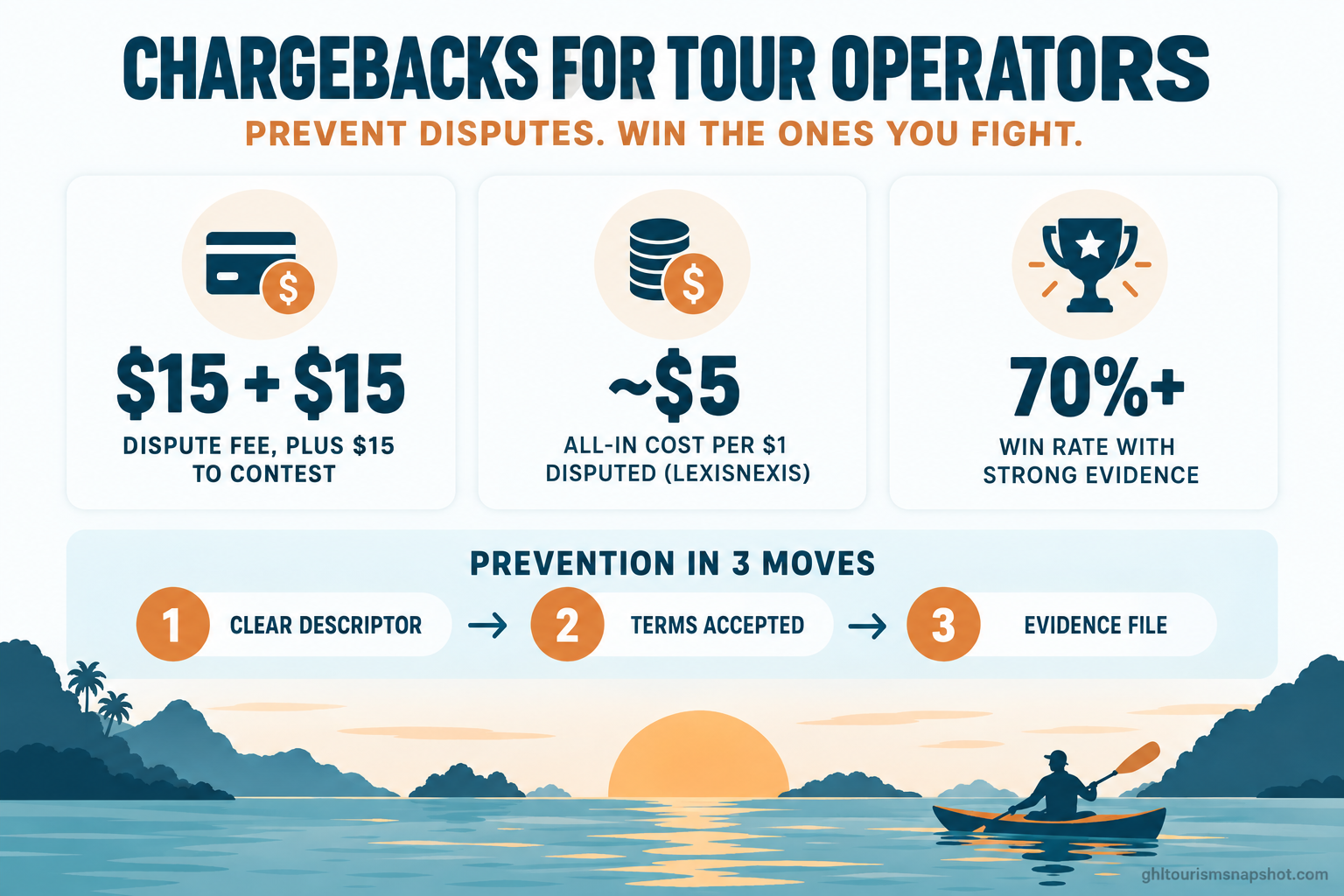
When a traveler disputes a charge, their bank pulls the money out of your account first and asks questions later. You are guilty until you prove yourself innocent, and down the cash meanwhile. Then the fee lands on top. Stripe charges a $15 dispute fee on every chargeback, and since mid-2025 adds a second $15 fee if you contest it, refunded only if you win (Stripe). A disputed $340 tour is not a $340 problem. It is $340 gone, $15 for the dispute, another $15 to fight it, and an hour of your evening.
Zoom out and it gets worse. Counting the fee, the lost service, and the labor to handle it, industry research puts the all-in cost at roughly $5 for every $1 disputed (LexisNexis True Cost of Fraud), and Mastercard expects the global cost of chargebacks to merchants to reach about $42 billion by 2028 (reported via Chargeflow).
For a small shop, one or two disputes a month is not a rounding error. It is a guide shift, a fuel tank, a chunk of the marketing budget. The good news: this is a systems problem, and systems problems have fixes you build once.
Why tour bookings get disputed in the first place
Before you can prevent a dispute, you need to know what you are preventing. In this business, chargebacks cluster into five buckets, and only one is real theft.
One: the customer does not recognize the charge. They booked “Blue Wave Kayak Tours” in July, but their statement shows “BWKT LLC” or a processor default. Months later they scan the statement, do not recognize it, and dispute. The easiest one to prevent and one of the most common.
Two: no-shows and late cancellations. They booked, did not read your policy, missed the trip or canceled an hour before, got charged your fee, and disputed it out of frustration. These land under “cancelled services” codes, and are winnable only if the traveler clearly agreed to the policy up front.
Three: weather and operator cancellations gone sideways. You canceled for lightning, offered a rebook, they wanted cash, the refund talk broke down, and they went to the bank. Our weather cancellation playbook covers keeping these out of dispute, because they are a communication failure, not fraud.
Four: “not as described.” The trip ran, but it was not what they pictured: shorter, more crowded, a substitute guide, a route change. This one is subjective, which makes it harder to win, and where your booking page wording matters most.
Five: actual fraud. A stolen card was used to book. Real, but the smallest slice. The uncomfortable truth is that most disputes come from your real customers: Visa reports first-party misuse, a genuine cardholder disputing a genuine charge, running up to 30% of disputes for online merchants (Visa).
Illustrative share of tour and activity chargebacks by cause. Fraud is the smallest slice; most disputes come from real customers. Categories per Visa dispute reason codes.
Notice that four of the five buckets are about clarity and communication, not crime. Fix the clarity and you prevent most disputes before they reach a bank.
The chargeback-proof booking system, stage by stage
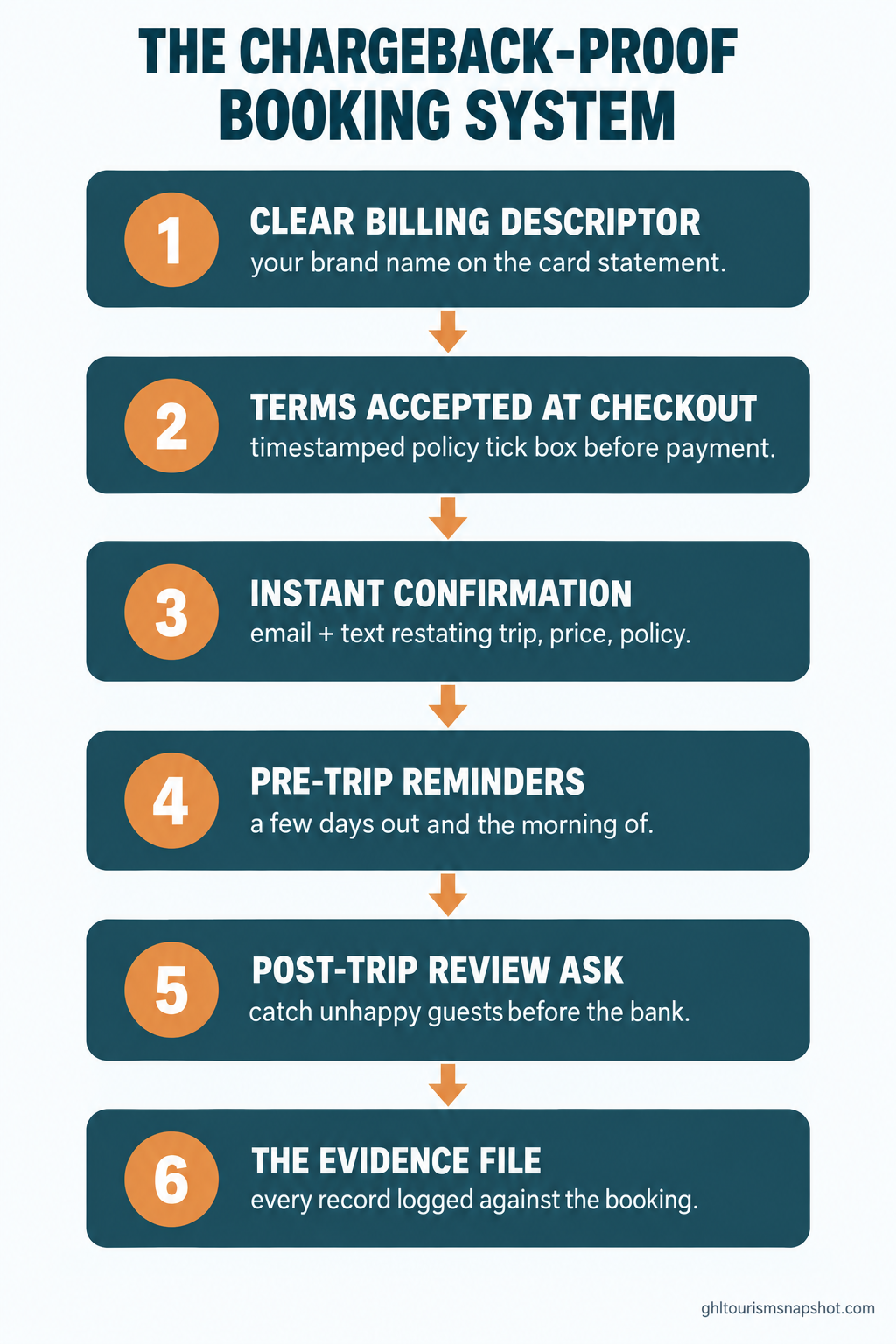
Here is the system we set up for operators. Each stage prevents a bucket above, with the setup, how it breaks, and the copy you can steal.
Stage 1: Set a billing descriptor they will recognize
Your billing descriptor is the text on the traveler’s card statement. If it is your legal entity name or a processor default, you are manufacturing “I do not recognize this charge” disputes. Set it to your public brand name in your payment settings.
How it breaks: the descriptor is capped around 22 characters, and many operators never change the default. A traveler who booked three months ago will not connect “SQ LLC 8829” to a kayak trip.
Stage 2: Get the terms accepted before they pay
This is the most important stage. Card networks require operators to disclose cancellation and no-show terms in writing before charging a card, and a recorded, timestamped acceptance is the evidence banks weigh most heavily (Chargebacks911). A checkbox the traveler ticks, logged with a date and time, does most of the work of winning a future dispute.
Your terms need to cover three things in plain language: your cancellation and refund window, your no-show and late-arrival policy, and what happens in bad weather. If you sell across state lines, they also intersect with travel-seller rules, covered in the compliance checklist.
How it breaks: the policy lives on a “Terms” page nobody clicks, with no checkbox at checkout. If the traveler never actively agreed, a “cancelled services” dispute is hard to defend. The fix is a tick box on the booking form, not a link in the footer.
Stage 3: Send an instant, timestamped confirmation
The moment they pay, fire a confirmation by email and text restating what they booked, the date and time, the price, and the policy they agreed to. It reassures the traveler so they do not panic-dispute, and creates a second timestamped record for a bank later.
How it breaks: the only confirmation is the processor’s generic receipt, which does not mention your trip, policy, or brand. Or worse, nothing sends at all, and the traveler stares at a charge with no context.
Stage 4: Remind them before the trip
No-shows become chargebacks when a traveler forgets, misses the trip, gets charged a fee, and disputes it in anger. A short reminder sequence, one a few days out and one the morning of, cuts no-shows and lets frustrated travelers reschedule instead of reaching for the dispute button. We go deep on this in our guide to cutting tour no-shows. One caution: automated reminder texts are governed by TCPA and A2P rules, so you need consent and an opt-out, which the SMS marketing playbook covers.
How it breaks: reminders that only nag (“don’t forget”) without an easy reschedule link. If canceling or moving the booking is hard, the traveler picks the easy option, which is calling their bank.
Stage 5: Close the loop after the trip
Send a thank-you and receipt within a day, and ask for a review. A happy traveler who just left you five stars almost never disputes the charge, and if something went wrong, your follow-up gives them a private channel to complain to you instead of a public one to their bank. That stops a “not as described” dispute before it starts.
How it breaks: silence after the trip. An unhappy traveler with no way to reach you, and a charge they now resent, is a dispute waiting to happen. A nudge that routes unhappy guests to you and happy ones to Google turns that around, as our five-star reviews playbook shows.
Stage 6: Keep the evidence file
Every stage above quietly builds the file you need if a dispute still lands. In one place per booking: the timestamped terms acceptance, the confirmation, the reminder history, any replies, the waiver if you use one, and proof the trip ran (a check-in, a photo, a guide log). When a dispute comes in, you assemble a folder instead of reconstructing a memory.
How it breaks: the records are scattered across your inbox, booking tool, phone, and a clipboard. By the time you find them, the response window is closing. A system that logs all of this automatically is the difference between a five-minute response and a lost evening.
How to fight a chargeback and actually win
Prevention handles most of it, but some disputes land anyway. Each arrives with a reason code that tells you what the traveler claimed, and the code decides what evidence wins. Here are the ones tour operators see most, with the Visa versions as the example.
| Reason code | What the traveler claims | Evidence that wins |
|---|---|---|
| 10.4 Card-absent fraud | “I didn’t make this purchase” | Matching name, AVS/CVV match, IP, booking + check-in records |
| 13.1 Services not received | “The trip never happened” | Confirmation, check-in log, guide roster, trip photos |
| 13.3 Not as described | “It wasn’t what was advertised” | Your booking page copy, itinerary agreed to, photos, reviews |
| 13.7 Cancelled services | “I was charged after canceling” | Timestamped policy acceptance, cancellation window, comms |
Sources: Visa reason codes via Chargeback.io, Visa 13.3.
A cardholder generally has up to 120 days to file most disputes, which is why a booking from months ago can surface now (Chargeback.io). Once it lands, your window to respond is short, often 7 to 21 days, and missing it is an automatic loss (Stripe). Speed matters, which is why the Stage 6 evidence file is worth building before you need it.
When you respond, called representment, submit your evidence in one clear package. Do not dump everything; answer the specific claim. For a 13.7 “I canceled” dispute, lead with the timestamped terms acceptance and cancellation window; for a 13.1 “it never happened,” lead with the check-in and the photo. Average win rates sit around 20% to 30%, but operators who prepare push past 70% (Chargebacks911).
One honest note: not every dispute is worth fighting. If the amount is small and your evidence thin, contesting costs another $15 and your time for little gain. Fight the ones where you have the records and the principle. Prevent the rest.
What this looks like for a solo, mid-size, and large operator
The system is the same. The scale of the answer is not.
The solo operator. One guide, maybe 300 bookings a season, running the business from a phone. Disputes are rare but brutal, because one $340 chargeback is a real dent. Stick to the cheap, high-impact basics: fix the billing descriptor today, add the checkout checkbox, and turn on an automated confirmation and a day-before reminder. You do not need a disputes department. You need the three records that win almost every dispute, created automatically so you forget about them until the rare day you need the folder.
The mid-size operator. Three to six tour types, a couple of year-round staff, maybe $300,000 in online bookings. You will see disputes monthly, and ignoring them is now a real line item. You want the full system plus one person who owns the evidence folder and responds inside 48 hours. This is where a disconnected stack hurts: your booking tool, inbox, and texts do not talk, so building an evidence file means three logins. Pulling those onto one connected platform pays for itself in recovered disputes and saved hours.
The large operator. Multiple locations, thousands of bookings, real exposure. Disputes are a managed process with a target win rate, not a fire drill. You track your dispute ratio (keep it well under the 1% card networks flag), template your responses by reason code, and watch for patterns that signal a fixable leak. At your scale, a half-point improvement is tens of thousands of dollars, so the system earns a named owner and a monthly review.
Common objections
“Won’t a strict cancellation policy scare off bookings?” A clear policy does not cost you bookings. A hidden or harsh one does. Travelers book hotels and flights with cancellation windows every week; what they hate is surprise. State the policy plainly at checkout, make weather cancellations generous and free to rebook, and you look professional, not stingy.
“I already use a booking tool. Doesn’t it handle disputes?” Mostly no. Booking tools take the payment and often pass the dispute notice through, but they rarely set your descriptor, force a terms checkbox, or assemble the evidence file across your emails and texts. Defending the booking is still on you, as we cover in what booking software actually costs.
“Isn’t fighting chargebacks a waste of time if I usually lose?” You lose when you respond late with scattered evidence. You win when you respond fast with the three records this guide is built around. The gap between a 25% and a 70% win rate is preparation, not luck.
“Do I need to be technical to set this up?” No. Every piece here is a setting or a template: a descriptor field, a checkbox, an automated message, a folder. You can wire it yourself over a weekend, or have it installed done-for-you. Either way, it runs on its own once it is built.
Back to that Monday morning
Picture that disputed kayak charge again, this time with the system in place. The descriptor says BLUEWAVE KAYAK TOURS, so the family recognizes it and never disputes. Even if they had, you open the contact and there it is: the terms they ticked at 9:14pm on July 3rd, the confirmation, the reminder, the pier check-in, and the photo. You attach the folder, write two sentences, and win inside the day.
Chargebacks feel like bad luck, but for a tour operator they are mostly a systems gap, and systems gaps close once. Set the descriptor, get the terms accepted, confirm and remind, follow up, and keep the file. Do that and the disputes that used to cost you a season’s margin become a rare, five-minute chore you almost always win.
Chargebacks for tour operators: FAQ
How long does a customer have to dispute a tour booking?
For most disputes, a cardholder generally has up to 120 days from the transaction or expected service date, which is why a booking from months earlier can appear as a chargeback now. Your window to respond is much shorter, often 7 to 21 days depending on the card network and processor.
What is the single best way to prevent tour chargebacks?
Get the traveler to actively accept your cancellation, no-show, and weather policy at checkout, logged with a timestamp. Card networks treat that recorded acceptance as strong evidence against the most common dispute, where a customer claims they were charged unfairly after a no-show or late cancellation.
Does a chargeback cost more than the refunded amount?
Yes. On top of the lost booking, Stripe charges a $15 dispute fee plus another $15 if you contest it (refunded only if you win). Counting the fee, lost service, and your time, industry research puts the all-in cost at roughly $5 for every $1 disputed.
Can I win a chargeback for a trip the customer actually took?
Often yes, if you kept records. Submit the timestamped terms acceptance, the confirmation, a check-in or guide log showing they attended, and a photo if you have one. Organized evidence pushes win rates past 70%, versus 20% to 30% for a late or scattered response.
What should my billing descriptor say?
Your public brand name, matched to your website and confirmation emails, plus a phone hint if you have room (BLUEWAVEKAYAK 555-0142). Descriptors are capped around 22 characters. A recognizable one prevents the most common dispute: 'I don't recognize this charge.'